
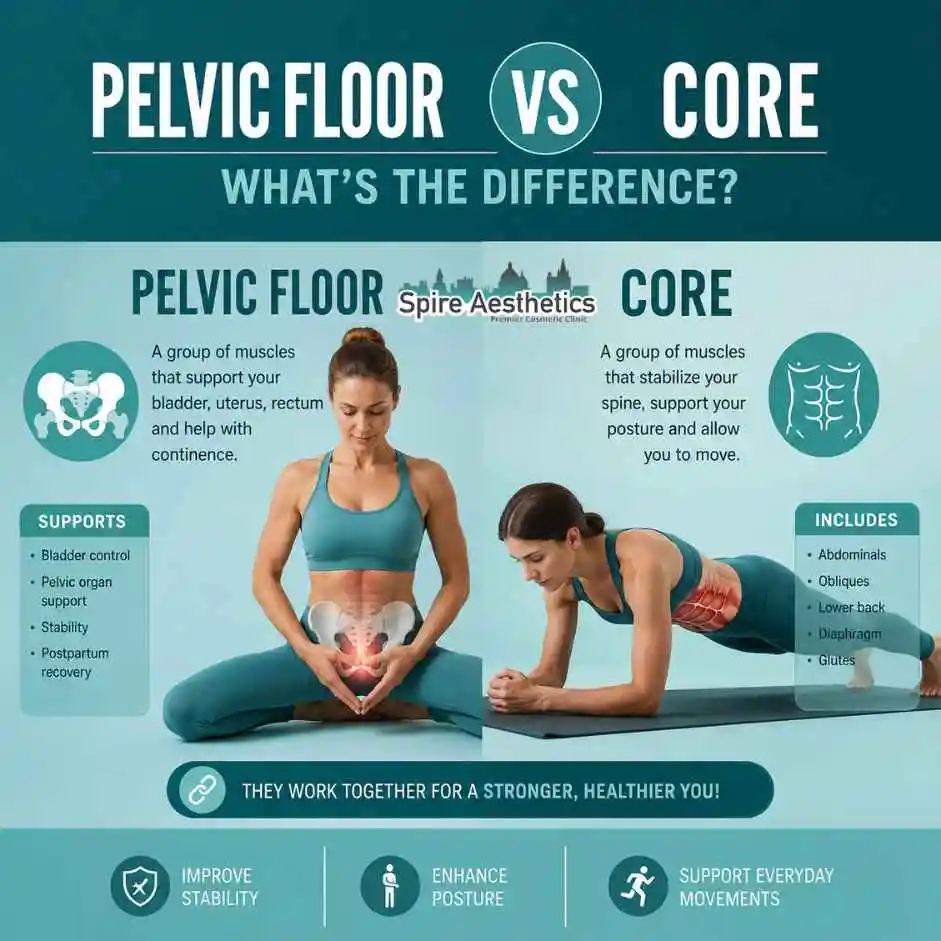
Many people use the terms pelvic floor and core interchangeably, but they aren’t the same thing. While they work closely together, each has a unique role in supporting your body. Understanding the difference can help explain symptoms such as lower back pain, abdominal weakness, bladder leaks, poor posture, or the feeling that your body hasn’t fully recovered after pregnancy.
For many women, these changes don’t happen all at once. They often develop gradually following pregnancy, significant weight changes, abdominal surgery, or simply as the body ages. Unfortunately, it’s common to dismiss these symptoms as a normal part of life or assume that doing endless sit-ups and planks will fix the problem.
In reality, improving your core strength starts with understanding how your pelvic floor, abdominal muscles, diaphragm, and deep stabilising muscles work together. If one part of the system isn’t functioning properly, the entire core can become less effective.
Let’s explore the difference between the pelvic floor and the core, why they both matter, and how restoring muscle function can help you move, exercise and feel more confident.
What Is the Difference Between Your Pelvic Floor and Your Core – and Why Do So Many People Confuse Them?
Your core is much more than your abdominal muscles. It’s a group of muscles that stabilise your spine, pelvis and torso during every movement you make.
The core includes:
- The diaphragm
- Deep abdominal muscles (particularly the transverse abdominis)
- Back muscles
- The pelvic floor muscles
This means your pelvic floor is actually one important part of your core, rather than being separate from it.
Your pelvic floor is made up of muscles and connective tissues that sit across the base of your pelvis. Their job is to support the pelvic organs, help maintain bladder and bowel control, and work alongside your core muscles to keep your body stable during movement. Pelvic Floor Chair Therapy
People often mix up the pelvic floor and the core because they work as a team. Every time you breathe, lift something, cough, sneeze or move, these muscles automatically work together to provide stability and support.
If one area becomes weak, the other often has to compensate.

Could a Weak Core Be the Real Reason Behind Your Back Pain, Poor Posture and Persistent Belly Bulge?
Many people think a weak core simply means having poor abdominal definition, but it affects much more than appearance.
A weak core can affect much more than your fitness. It may lead to:
- Persistent lower back pain
- Poor posture throughout the day
- Reduced balance and stability
- Difficulty lifting or carrying everyday items
- Feeling less stable during physical activity or exercise
- A tummy that continues to protrude despite losing weight
- Becoming fatigued more easily when carrying out everyday tasks
During pregnancy, the abdominal muscles naturally stretch to make room for your growing baby. In some cases, these muscles don’t fully come back together afterwards, resulting in a condition called diastasis recti.
When the abdominal wall loses tension, the core cannot generate pressure efficiently. This may leave everyday tasks feeling harder and make exercise less effective. Is Surgery the Only Way to Fix Diastasis Recti?
Simply doing more crunches or sit-ups isn’t always the answer. In some cases, these exercises can increase pressure on the abdominal wall without improving muscle function.
Recovery usually begins by rebuilding deep muscle activation before gradually introducing more challenging exercises.
How Does Pelvic Floor Dysfunction Affect Everyday Life More Than Most People Realise?
Pelvic floor problems are far more common than many people realise, yet they’re rarely discussed openly.
A weakened pelvic floor can affect daily life in subtle ways before symptoms become more noticeable.
Common symptoms may include:
- Leaking urine when coughing, sneezing or laughing
- Finding it difficult to control wind
- A sensation of pressure or heaviness in the pelvic area
- Feeling less confident when exercising
- Discomfort during everyday movements or physical activity
- Difficulty activating the deep abdominal muscles
Many women assume these symptoms are simply part of ageing or motherhood.
While pregnancy and childbirth place additional strain on these muscles, ongoing symptoms shouldn’t simply be accepted as inevitable. How to Check for Diastasis Recti at Home
Improving pelvic floor function can help many people regain confidence, improve movement and feel more comfortable during daily activities.
Can Strengthening Your Core Alone Actually Make Pelvic Floor Problems Worse?
One of the biggest misconceptions is that intense abdominal training automatically strengthens the entire core.
In reality, exercises that create excessive pressure inside the abdomen may place additional strain on the pelvic floor if those muscles aren’t functioning properly.
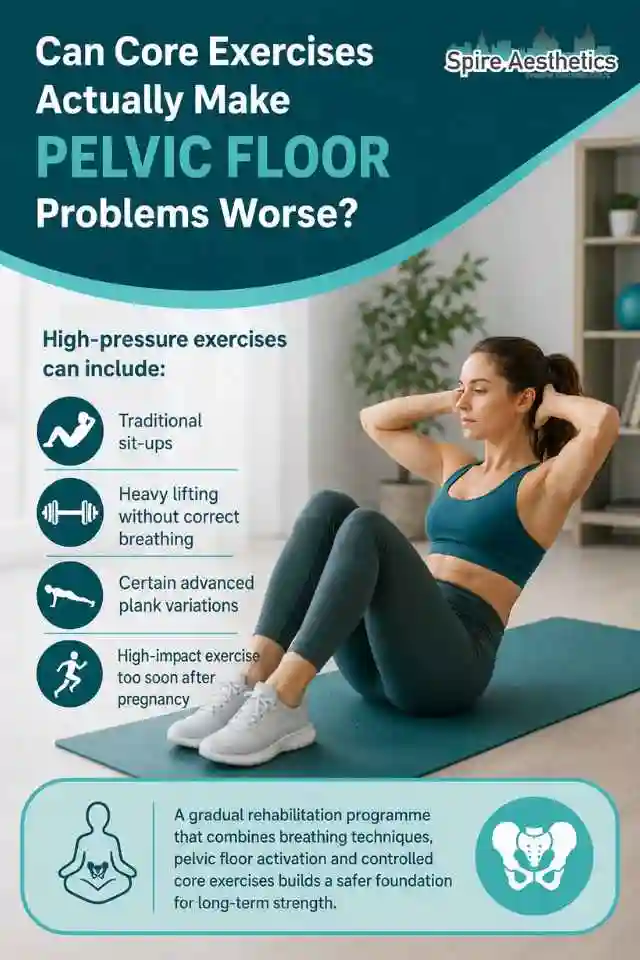
High-pressure exercises can include:
- Traditional sit-ups
- Heavy lifting without correct breathing
- Certain advanced plank variations
- High-impact exercise performed too soon after pregnancy
That doesn’t mean these exercises are harmful for everyone. Rather, they should be introduced when the body is ready and when deep core muscles are functioning effectively.
A gradual rehabilitation programme that combines breathing techniques, pelvic floor activation and controlled core exercises often provides a safer foundation for long-term strength.
What Is the Best Way to Strengthen Both Your Core and Pelvic Floor Together?
The most effective rehabilitation doesn’t isolate one muscle group. Instead, it teaches the body to work as an integrated system.
Helpful strategies often include:
- Learning diaphragmatic breathing
- Activating the deep abdominal muscles
- Learning how to activate the pelvic floor effectively
- Maintaining good posture whether sitting, standing or moving
- Building strength progressively at a pace that suits your body
- Focusing on steady, long-term improvement instead of quick results
Recovery isn’t about doing countless repetitions every day. It’s about training the right muscles consistently and allowing them to become stronger over time.
Small, controlled movements performed correctly usually produce better long-term improvements than rushing into demanding workouts. Non-Surgical Treatments From Spire Aesthetics: Be More Confident With Ageing
Seeking professional advice can also help identify whether symptoms relate to muscle weakness, abdominal separation or another underlying issue.
When Could Diastasis Recti Be the Missing Piece of the Puzzle?
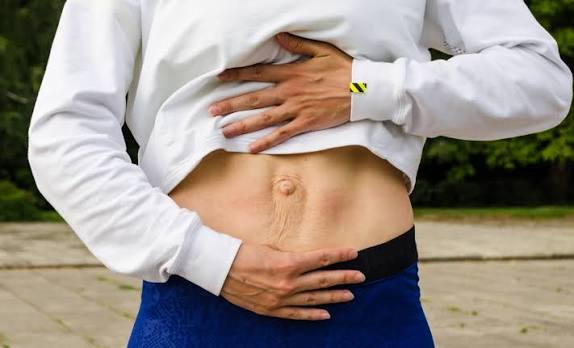
When the central connective tissue of the abdomen becomes overstretched, it can cause the abdominal muscles to pull apart, resulting in diastasis recti.
Although it most commonly develops during pregnancy, it can also affect others following significant weight changes or repeated increases in abdominal pressure.
Signs may include:
- A bulge down the middle of the abdomen
- Core weakness
- Poor posture
- Lower back discomfort
- Difficulty lifting
- Ongoing abdominal instability
Because the abdominal muscles struggle to generate effective support, the pelvic floor may also have to work harder.
For this reason, treating abdominal separation isn’t simply about improving appearance. Restoring abdominal muscle function can help improve stability, movement and confidence in everyday life.
How Can Spire Aesthetics Help Restore Core Function Without Surgery?
At Spire Aesthetics Berkshire, we understand that every person’s recovery journey is different. Some clients have worked hard with exercise programmes but continue experiencing abdominal weakness, reduced core stability or concerns about diastasis recti.
Our Diastasis Recti Treatment is designed to support suitable clients looking for a non-surgical option to improve abdominal muscle function and strengthen the core.
Following a detailed consultation, our experienced team assesses your individual concerns and recommends a personalised treatment plan based on your goals and current muscle function.
For many clients, combining professional treatment with appropriate exercise, healthy lifestyle habits and ongoing rehabilitation offers a practical pathway towards improved strength, posture and body confidence.
Every treatment is personalised to suit your needs and objectives, helping you feel reassured, supported and confident at every stage of your recovery.
Frequently Asked Questions
Q: Is it possible to have a strong core but a weak pelvic floor?
Yes. Although the pelvic floor is part of your core system, having strong abdominal muscles doesn’t necessarily mean your pelvic floor is functioning well. You can still experience pelvic floor weakness, reduced muscle control or symptoms such as bladder leaks despite having good core strength.
Q: Why does my stomach still stick out even though I work out regularly?
A noticeable tummy bulge isn’t always caused by excess body fat. Weak core muscles, poor muscle engagement or diastasis recti may prevent the abdominal wall from functioning effectively. In these cases, targeted rehabilitation is often more beneficial than simply increasing the number of abdominal exercises you perform.
Q: What are the warning signs that my pelvic floor and core need attention?
You may notice symptoms such as persistent back pain, reduced abdominal strength, bladder control issues, poor posture, pelvic discomfort or instability during physical activity. These can all indicate that your core muscles aren’t working together efficiently.
Q: Is it important to strengthen my pelvic floor before doing core exercises?
Yes, for many people it is. The pelvic floor nurtures strength alongside those deep core muscles, creating a much stronger foundation to build upon so that you can move safely and effectively into higher-level exercises. Maybe a professional assessment is needed to find out how best to meet your needs.
Q: Can diastasis recti weaken both my core and pelvic floor?
Yes. Diastasis recti can reduce the stability and effectiveness of your core muscles. As a result, the pelvic floor may become overworked as it tries to provide additional support, potentially leading to weakness, reduced stability and other related concerns.
Q: How can Spire Aesthetics help if I think diastasis recti is contributing to my core weakness?
Spire Aesthetics offers professional assessment and non-surgical diastasis recti treatment for suitable clients. Following a consultation, the team develops a personalised treatment plan to help improve abdominal muscle function, support core stability and enhance overall confidence
For Further Information, please call us on 03300100092